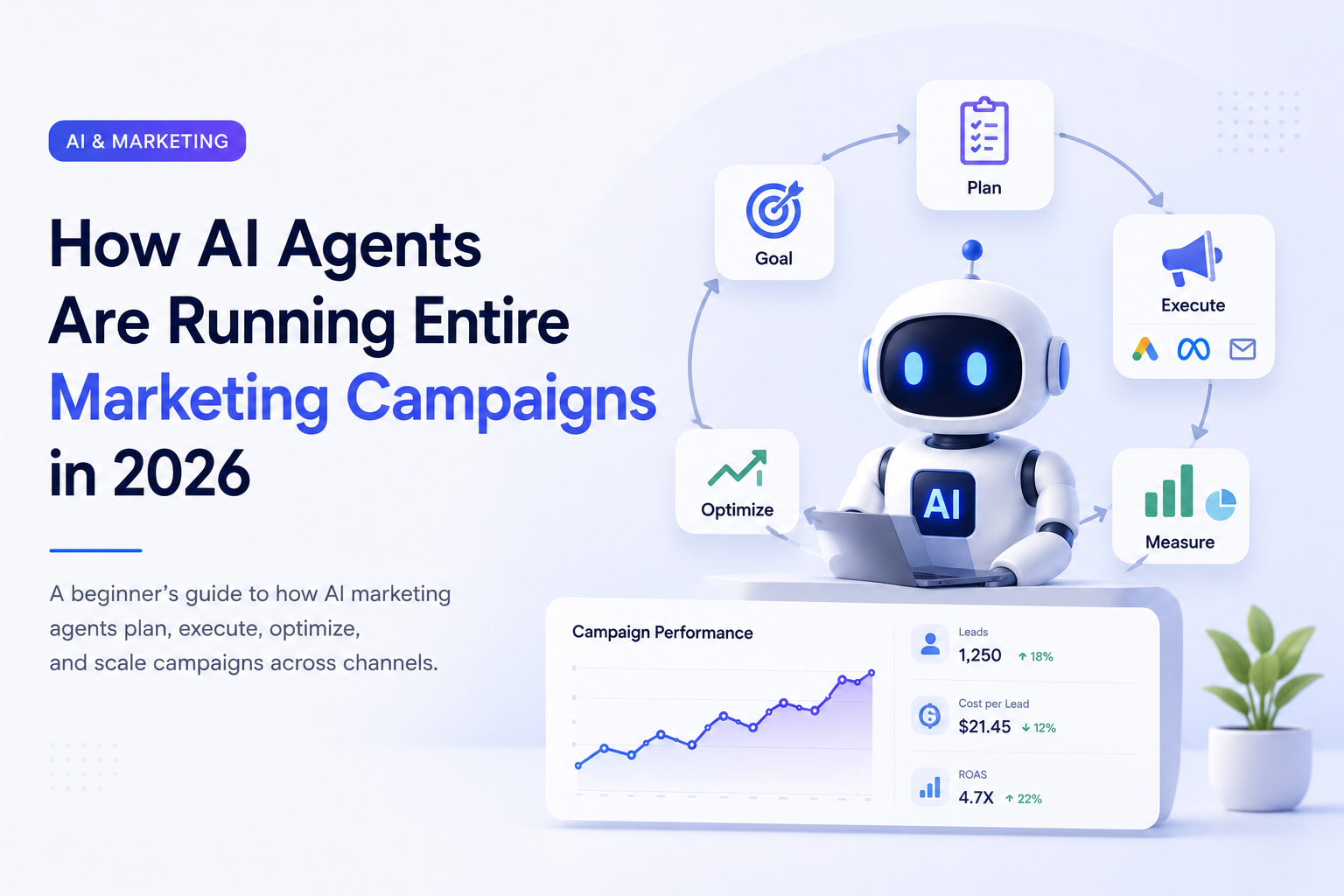
Marketing used to mean a lot of tabs, spreadsheets, dashboards, and repetitive tasks.
You would write an ad. Check the numbers. Change the headline. Schedule an email. Review the results. Adjust the budget. Then do it all again the next day.
For a small business owner or solo marketer, that can quickly feel like a full-time job.
But in 2026, something important has changed.
AI is no longer limited to helping marketers write things. A new generation of AI agents can help plan, execute, monitor, and optimize marketing campaigns with much less manual involvement.
That’s what makes AI agents marketing campaigns different from the AI tools most people are already familiar with.
Instead of asking an AI tool to write five Facebook ads and then doing the rest yourself, you can give an agent a goal, connect the relevant marketing platforms, and let it handle parts of the campaign workflow automatically.
That doesn’t mean marketers can disappear completely. Human strategy, creativity, approval, and oversight still matter.
But the amount of repetitive work one person can manage is changing quickly.
In this guide, we’ll look at what AI marketing agents actually are, how they’re being used in 2026, what they can automate, how much they cost, their limitations, and how a small business can start using them without turning the whole marketing operation upside down.
What Makes an AI Agent Different From a Regular AI Tool?
Let’s start with the basic distinction.
Most people have used AI by typing a prompt into a tool such as ChatGPT and getting an answer.
For example:
“Write five Google Ads headlines for my accounting business.”
The AI gives you the headlines. You review them, copy them into your advertising platform, launch the campaign, check the results, and decide what to change.
The AI helped with one task.
An AI agent is designed to work toward a broader objective.
You might tell an agent:
“Generate more qualified leads while keeping our cost per lead below $30.”
Instead of simply producing text, an agent may be able to:
- Understand the goal
- Break the goal into smaller tasks
- Analyze available data
- Create marketing assets
- Connect with external tools
- Take approved actions
- Monitor campaign performance
- Make adjustments based on results
- Report what it changed
The easiest way to think about it is this:
Traditional AI: You give it instructions for individual tasks.
AI agent: You give it an objective and allow it to complete a workflow.
It’s similar to the difference between having a very fast assistant who waits for instructions and having a junior marketing operator who can take a defined task from start to finish.
Of course, today’s agents still have limitations. They aren’t experienced marketing directors who understand every nuance of your business.
That’s why human oversight remains important.
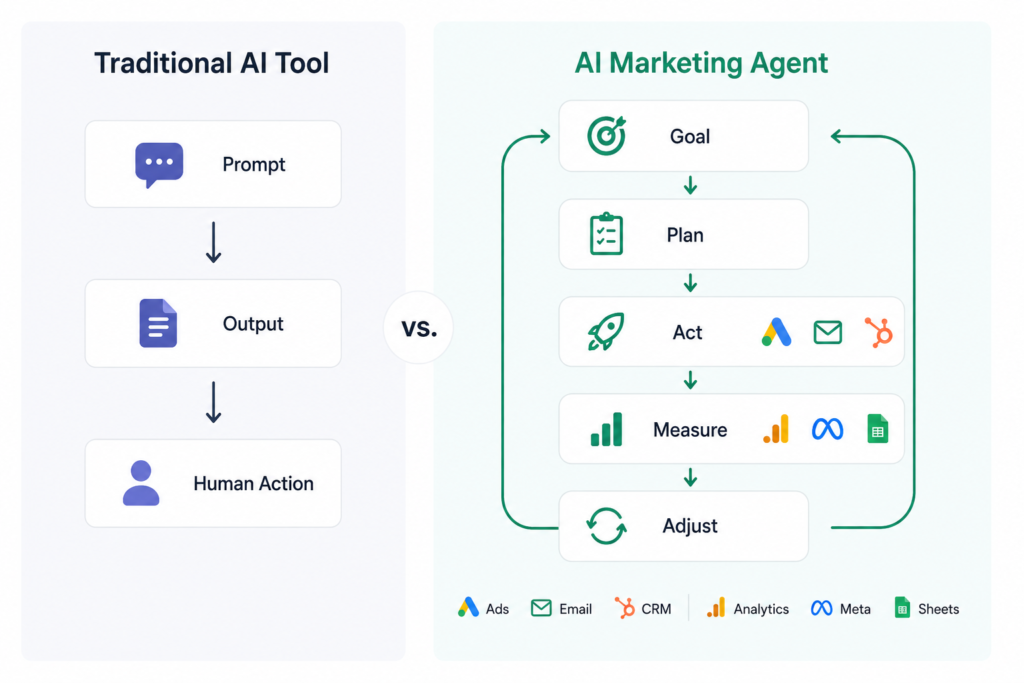
Traditional AI vs. AI Marketing Agents
Traditional AI tools
Prompt → Generate → Human reviews → Human executes
AI marketing agents
Goal → Plan → Execute → Measure → Adjust → Repeat
The second workflow is where the real productivity gains start to appear.
How AI Agents Are Actually Running Marketing Campaigns in 2026
This is where AI marketing becomes much more interesting.
The technology isn’t just about generating blog posts or social media captions anymore. Marketing automation is increasingly moving into the execution layer.
A typical agent-powered workflow can look something like this.
1. Connect Your Marketing Accounts
The first step is usually connecting the tools the agent needs.
Depending on the platform, that might include:
- Google Ads
- Meta Ads
- Google Analytics
- CRM software
- Email marketing platforms
- Social media accounts
- E-commerce platforms
Once connected, the agent can access the information it needs to perform its assigned tasks.
2. Set a Goal
Next, you define what success looks like.
For example:
- Generate 100 leads
- Increase email signups
- Reduce cost per lead
- Increase online sales
- Improve ROAS
- Increase qualified website traffic
A specific goal is much more useful than simply telling an agent to “do better marketing.”
3. Let the Agent Build the Campaign
Depending on the platform, an AI agent may be able to create:
- Ad copy
- Headlines
- Audience variations
- Email campaigns
- Social posts
- Landing-page copy
- Creative variations
- Campaign structures
Instead of starting from a blank page, the marketer gives the system a goal and relevant business information.
4. Launch and Monitor
This is one of the biggest differences between ordinary AI content tools and agentic systems.
An agent can monitor campaign data instead of stopping after generating the initial content.
It may watch metrics such as:
- Click-through rate
- Conversion rate
- Cost per acquisition
- Cost per lead
- Return on ad spend
- Engagement
- Email performance
5. Adjust Based on Performance
Suppose one advertisement consistently generates cheaper conversions than another.
An agent may be able to reduce spending on the weaker variation and allocate more budget toward the stronger one, depending on its permissions and the platform’s capabilities.
The important point is that the workflow doesn’t necessarily end when the campaign launches.
The system can continue through the measure → learn → adjust cycle.
6. Report the Results
Instead of manually opening several dashboards every morning, the agent can provide a summary of what happened.
A useful report might explain:
- What changed
- Which campaign performed best
- Where money was moved
- Which creative performed poorly
- What the agent recommends doing next
That gives the human marketer more time to focus on strategy rather than repetitive dashboard work.
A Simple Example: AI Agents for a Skincare Brand
Imagine you run a small skincare company.
Normally, you might need to:
- Write several ad variations.
- Create different campaign audiences.
- Upload the creative.
- Launch the campaign.
- Check performance every day.
- Compare conversion costs.
- Pause weak advertisements.
- Create new variations.
- Adjust the budget.
- Prepare a performance report.
That’s a lot of manual work.
With an AI-agent workflow, some of those tasks can be automated.
You could provide the agent with your product information, target customer, campaign objective, budget, and performance limits.
The system could then create several variations, launch approved campaigns, monitor the results, identify stronger performers, and make permitted adjustments.
You still decide the strategy.
The agent simply handles more of the repetitive execution.
That’s the real promise of agentic AI marketing.
It’s not necessarily about replacing the marketer.
It’s about allowing one marketer to operate at a much larger scale.
Real AI Marketing Agent Tools and Platforms
There isn’t one AI marketing agent that is perfect for every business.
The right choice depends on what you’re trying to automate.
A business focused on paid advertising has different requirements from an e-commerce store looking to automate email marketing or a B2B company trying to qualify leads.
Here are the major categories to understand:
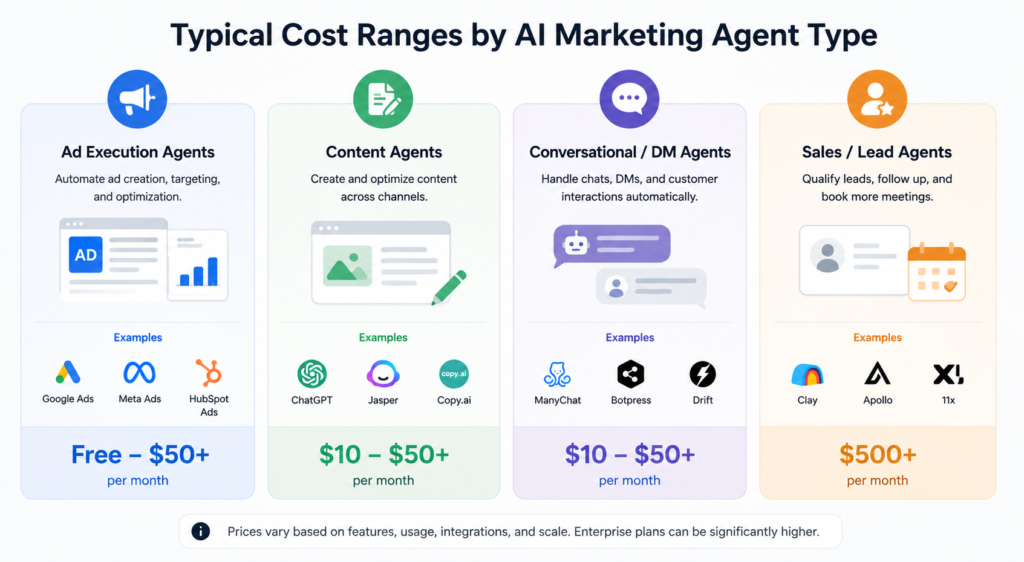
| Tool Category | What It Can Handle | Typical Starting Range |
|---|---|---|
| Ad execution agents | Campaign creation, testing, monitoring, optimization | Often around $50/month and up |
| Content and brand agents | Blog, email and social content | Free to roughly $10–$50/month |
| Conversational agents | Customer questions, lead qualification, DMs | Free tiers to $15+/month |
| Sales and lead agents | Lead research, enrichment and routing | Often $500+/month for advanced systems |
Prices vary considerably by provider, usage, integrations, and features, so treat these as rough categories rather than fixed market prices.
For a small business, there’s usually no reason to jump directly into an expensive enterprise platform.
Start with the workflow that’s causing the biggest operational headache.
Why AI Agents Are Becoming More Important
So why is everyone suddenly talking about AI agents?
There are several reasons.
Marketing Is Becoming More Complex
Businesses now have more channels to manage than ever.
A typical marketing operation may include:
- Google Search
- Social media
- Content marketing
- Paid advertising
- SEO
- AI search visibility
- CRM follow-ups
- Retargeting
Managing all of those manually can become expensive.
Automation helps businesses handle more channels without necessarily increasing headcount at the same rate.
Search Is Changing
Search behavior is also evolving.
People increasingly use AI-powered interfaces to research products, compare options, summarize information, and answer questions.
That means businesses aren’t only competing for traditional search clicks anymore.
They also need to think about visibility across AI-powered discovery environments.
For marketers, this creates another layer of work — and another reason automation is becoming attractive.
Speed Matters
Imagine two companies selling similar products.
Company A spends three days creating a new campaign.
Company B uses an agent-assisted workflow and can test several variations much faster.
If Company B can learn from its data sooner, it has more opportunities to improve the campaign.
The advantage isn’t simply “AI is smarter.”
It’s that the business can potentially test, learn, and react faster.
Small Teams Can Do More
This may actually be the biggest opportunity.
Large companies can hire specialists for paid advertising, content, email, analytics, social media, and marketing operations.
A small business usually can’t.
AI agents can help fill some of those operational gaps.
They don’t replace expertise, but they can reduce the amount of repetitive work required to put that expertise into practice.
What AI Marketing Agents Still Can’t Do Reliably
There’s a lot of excitement around AI agents, but it’s important to stay realistic.
Automation doesn’t automatically mean good marketing.
They Still Need Human Oversight
AI can produce inaccurate information, misunderstand context, or make a recommendation that looks reasonable but doesn’t fit your business.
That matters even more when the system has permission to take actions.
Human approval should remain part of important workflows, particularly when an agent can spend money, communicate with customers, or modify live campaigns.
They’re Not Completely “Set and Forget”
Giving an agent a goal doesn’t mean you should disappear for six months.
You should monitor the results and review important decisions.
A good approach is to start with limited permissions and expand them as you become comfortable with the system.
Integration Quality Can Vary
One platform might integrate beautifully with Google Ads and Meta but offer limited support for your CRM.
Another might have excellent email automation but weak advertising integrations.
Before buying anything, check whether it works with the tools your business already depends on.
Data Privacy Matters
Marketing systems often contain valuable customer information.
Before connecting an AI agent to your accounts, understand:
- What data it can access
- Where that data is processed
- How the provider stores it
- Which third parties receive the information
- What permissions the agent has
- Whether you can revoke access
Automation should never come at the expense of basic data security.
How to Start Using AI Agents for Marketing Without Overspending
You don’t need to automate your entire marketing department on day one.
In fact, that’s probably the wrong approach.
Start small.
Step 1: Find Your Biggest Time-Waster
Look at your weekly marketing routine.
Which task takes the most time?
Maybe it’s:
- Writing social posts
- Managing ads
- Following up with leads
- Creating email campaigns
- Reporting
- Research
- Content production
Pick one.
Step 2: Choose a Purpose-Built Tool
Don’t buy a huge platform simply because it has hundreds of features.
If your main problem is ad optimization, start with an advertising-focused solution.
If your problem is lead qualification, look at sales or conversational agents.
The best tool is the one that solves your actual problem.
Step 3: Start With a Free Trial
If a platform offers a free plan or trial, use it.
Don’t assume an expensive platform will automatically produce better results.
Test the workflow with real but controlled data.
Step 4: Give the Agent a Measurable Goal
Instead of:
“Get more customers.”
Try:
“Generate 30 qualified leads this month while keeping average cost per lead below $35.”
The second goal gives the system something measurable to work toward.
Step 5: Review Its First Decisions
For the first few weeks, pay close attention.
Look at:
- What it creates
- What it changes
- Where it spends money
- What it recommends
- Whether the results make sense
This is where you learn whether the system actually understands your business.
Step 6: Measure the Real ROI
Don’t only ask:
“Did AI generate good content?”
Ask:
“Did this automation save time or improve business results?”
Track:
- Hours saved
- Leads generated
- Sales
- Cost per acquisition
- Conversion rate
- Revenue
- Marketing spend
If the numbers improve, you have a reason to expand the workflow.
[IMAGE 3]
Suggested image placement: Beside or immediately after the six-step process.
Image prompt: A clean six-step visual workflow for adopting AI marketing agents: 1. Find the time-waster, 2. Pick a tool, 3. Start a trial, 4. Set a measurable goal, 5. Review decisions, 6. Track ROI. Use simple icons, arrows connecting each stage, minimal text, and a modern SaaS aesthetic.
Suggested alt text: Six-step process for starting with an AI marketing agent.
How Much Does AI Marketing Automation Cost?
The cost depends heavily on what you’re automating.
For a solo marketer, a simple content or productivity workflow may cost little or nothing.
More advanced advertising, sales, or enterprise systems can cost hundreds or thousands of dollars per month.
A useful way to think about the budget is:
Starter: Free to around $50/month
Good for testing content workflows, simple automation, and basic AI tools.
Growing business: Around $50–$500/month
Suitable for businesses using multiple AI-powered marketing workflows.
Advanced/enterprise: $500+/month
More appropriate when you need advanced sales automation, extensive integrations, larger usage limits, or sophisticated business workflows.
The important question isn’t:
“How cheap is the AI tool?”
It’s:
“How much valuable work can this tool reliably automate?”
A $100/month system that saves 20 hours and produces better results can be more valuable than a free tool that saves 30 minutes.
AI Agents vs. Hiring Another Marketing Employee
This comparison isn’t quite as simple as “AI is cheaper than people.”
An employee brings judgment, experience, creativity, communication skills, and business context.
An AI agent brings speed, consistency, automation, and the ability to execute repetitive workflows continuously.
For many businesses, the strongest model will be human + AI, rather than human versus AI.
The marketer decides:
- What the brand should stand for
- Who the customer is
- What the campaign should accomplish
- What risks are acceptable
- What messaging fits the company
The AI agent can help with:
- Research
- Drafting
- Testing
- Monitoring
- Reporting
- Repetitive execution
- Data-driven adjustments
That’s a much more realistic picture of where agentic marketing is heading.
Frequently Asked Questions About AI Agents Marketing Campaigns
What is an AI agent in marketing?
An AI marketing agent is software designed to work toward a marketing objective by planning tasks, using connected tools, taking actions, monitoring results, and adjusting its workflow based on new information.
The key difference from ordinary AI content generation is that an agent can participate in a multi-step workflow rather than simply returning one response to one prompt.
How are AI agents used in marketing campaigns?
AI agents can assist with campaign research, content creation, ad setup, audience analysis, lead qualification, email workflows, performance monitoring, reporting, and campaign optimization.
Exactly what an agent can do depends on the platform and the permissions you give it.
Can AI agents run Google Ads and Meta Ads?
Some AI-powered marketing platforms can connect with advertising platforms such as Google Ads and Meta and automate parts of campaign creation, monitoring, testing, and optimization.
However, capabilities vary significantly between providers. Always check the current integrations and permissions before giving an agent access to a live advertising account.
Can AI agents replace marketing agencies?
Not completely.
AI agents can automate repetitive execution and reduce the amount of manual work involved in campaign management. But strategy, positioning, creative direction, business judgment, and complex decision-making still benefit heavily from experienced marketers.
For many companies, AI is more useful as an operational layer alongside human expertise.
Do I need coding skills to use an AI marketing agent?
Usually not.
Many marketing-focused platforms are designed for non-technical users and provide integrations through account connections, dashboards, or no-code workflows.
Technical knowledge can become useful when you’re building custom agents or connecting specialized systems, but basic marketing automation generally doesn’t require programming.
How much does an AI marketing agent cost?
It depends on the type of agent.
Basic tools may offer free plans or cost around $10–$50 per month. More advanced systems for sales, advertising, data processing, or enterprise automation can cost hundreds or thousands of dollars per month.
The best starting point is usually the smallest plan that lets you test your specific workflow.
Are AI marketing agents worth it for small businesses?
They can be, especially when a business spends many hours each week on repetitive marketing tasks.
The key is choosing the right workflow.
Automating a task that takes 10 minutes a month won’t make much difference. Automating a task that takes 10 hours every week could have a meaningful impact.
Are AI marketing agents safe to use?
They can be used safely, but they should be deployed carefully.
Review the platform’s privacy practices, integrations, permissions, and security controls before connecting business or customer data.
You should also avoid giving an agent unrestricted access to important accounts until you’ve tested how it behaves.
Can an AI agent create a complete marketing campaign?
Some platforms can automate significant portions of campaign creation, including research, copy, creative variations, targeting, setup, and optimization.
However, “complete campaign” means different things across platforms.
A human should still define the business objective, positioning, budget limits, brand requirements, and approval rules.
What is the best AI marketing agent for a small business?
There isn’t one universal winner.
The best option depends on what you want to automate.
If you’re focused on advertising, choose a platform with strong ad integrations. If you’re focused on content, look for strong brand-voice and content workflows. If you’re focused on sales, prioritize CRM, lead enrichment, and conversational capabilities.
Start with the problem rather than the tool.
Should I automate my entire marketing operation at once?
No.
Start with one workflow.
Test it, measure the results, fix problems, and then expand.
This approach reduces risk and gives you a much clearer understanding of whether the automation is actually helping.
What is agentic AI marketing?
Agentic AI marketing refers to using AI systems that can independently perform multiple steps toward a marketing objective rather than simply generating content in response to individual prompts.
The basic cycle is:
Plan → Act → Measure → Learn → Adjust.
That continuous loop is what makes agentic systems different from traditional AI assistants.
Final Takeaways
AI agents marketing campaigns are moving from an interesting experiment to a practical part of modern marketing operations.
The biggest change isn’t that AI can write better headlines or generate social posts.
It’s that AI systems are increasingly able to participate in the entire workflow surrounding those assets — from planning and execution to monitoring and optimization.
For small businesses, that could be a major advantage.
You don’t need to automate everything.
You don’t need a massive AI budget.
And you don’t need to replace your marketing team.
Start with one repetitive task that’s consuming too much time.
Choose a focused tool. Set a measurable goal. Keep human oversight in place. Track the results.
If the system saves time and improves performance, expand it.
That’s the practical way to approach AI marketing in 2026: don’t automate for the sake of automation. Automate the work that keeps your business from moving faster.